The story
From a box of scrap electronics in Maringá to a van at the end of the world.

Chapter 00
The scrap kid
Londrina and Maringá, January 2005 to December 2009
I was born in Londrina because my mother refused to have me in São Paulo. The family was from there, but she hated the city, so close to the birth she went to stay with my paternal grandmother in Paraná. That is how Paraná became home.
My mother was a teacher and treated my sister and me as experiments in her career. My sister got a childhood of books. Mine was outdoors, and without toys. What I had was a giant basket of recyclables, packaging, paper towel tubes, styrofoam trays, a roll of masking tape and a pair of scissors. With that I made my own toys. The rest came from relatives at birthday parties.
My father trained as a librarian and worked as a sales manager. What he taught me fits in one sentence: if someone can do it, so can you. When my mother struggled to cook under the bad light of our rented apartment, he installed a fluorescent lamp under the cabinet the same day. I thought that was the most incredible thing in the world. It was my first contact with electronics.
I have loved scrap ever since. Everyone around me handed me their old devices, computers, DVD players, and I took everything apart to understand how it worked. I remember clearly that this is where I first felt flow, hours and hours locked in on building something out of those parts. My father taught me to solder, and that let me pull components out of scrap and reuse them elsewhere.
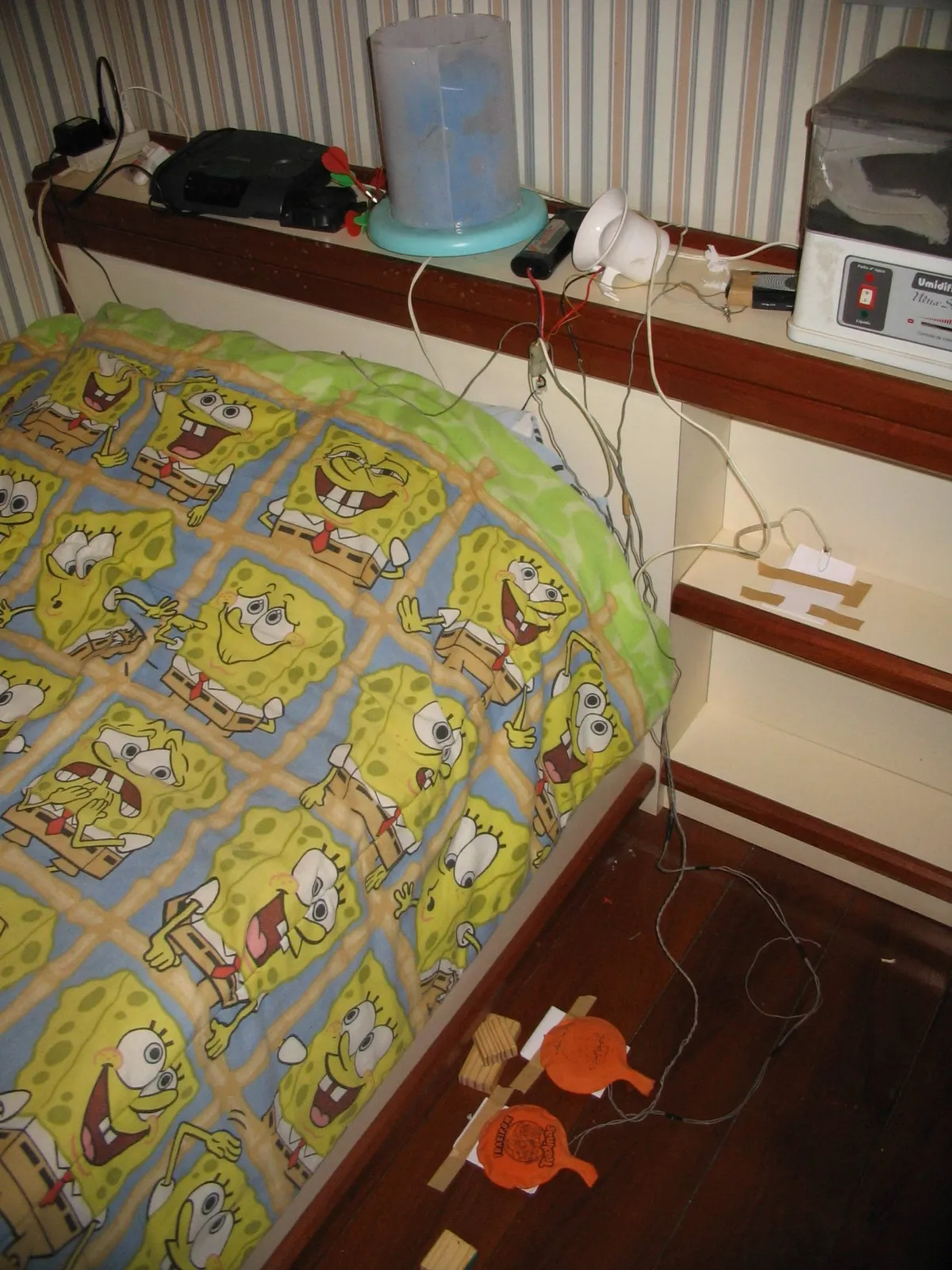
The first automation of my life was two wooden switches on the bedroom floor, next to the bed. I stepped on them when I woke up and they turned on the radio and the light. I have loved automating things ever since.
I also built wooden flashlights with electronics inside and sold them at school. One real in parts, fifteen at the counter. I made good money that way.
At home there was the family computer, a Pentium 4 with Windows XP, half a gig of RAM and an eighty gig drive. I spent whole afternoons poking around the internet and always ended up downloading adware. My father would get furious, and I had to fix the machine before he got home or lose it. I learned Windows the hard way.
When my friends started using MSN, I got into writing viruses to prank them. Batch scripting communities on Orkut were my first contact with programming. My programs shut the computer down or popped the CD drive open, with the icon swapped for some game of the day.
Around then Lego Mindstorms came out, the perfect union of both worlds: I could run my programs in real life. It cost four thousand reais, about ten minimum wages. My father managed to import one from the United States through a friend, a huge box, a real ordeal. It was canonical in my life. I still have it. Later I flashed custom firmware onto the NXT so it could run C++ directly, and that opened a door I still have not learned to close.
Chapter 01
The kid who shipped
Maringá, January 2010 to December 2014
A classmate told me about Sérgio Yamada, a programming school in Maringá. I enrolled in programming logic and it was the best thing I had ever done. I was twelve, surrounded by people over thirty. Everyone wanted to talk to me. Many doubted I would understand any of it, and some were sure my parents had forced me to be there.
Then PHP and MySQL, then advanced PHP. I wanted to work but I was twelve. A week in hospital with appendicitis, my father at my side, turned into long conversations about his company’s problems. PDVer, my first production software, came out of that bed: a tool for his sales reps to collect data at the point of sale.
After that I knocked on the door of DB1, the biggest software house in town, because I wanted to see what a real one looked like. I left with advice from a dozen developers and a name: Soraia Novaes.
Chapter 02
Desafio do Código
Maringá, October 2014 to April 2015
DB1’s HR pointed me to Soraia Novaes, who had just founded an NGO to teach programming to kids who would never pay for a course. I built the platform. It went into public schools in Maringá and Sarandi, and I taught with it wherever there was a room: classrooms, a McDonald’s, Animeingá, Ticnova.
Today it has more than 260,000 students and around 300 new sign-ups a day. It has been on SBT, Globo and Record.
In this chapter: Desafio do Código
Chapter 03
Losing my way into a scholarship
Maringá, January 2017 to December 2018
I started Computer Science at UEM in 2017 and, instead of studying, built the app the university did not have. It scraped the student portal for menus, schedules, grades and attendance, and ended up with 2,500 users across both stores. That same year my team placed 22nd at NASA Space Apps, and Unicesumar offered me a full scholarship, so I transferred.
Then came 2018: world finalist at NASA Space Apps, first place at the VISA Hackathon, first at Hacker Day Maringá. Onebot and Nappo started in the gaps between them.
In this chapter: UEM student app, Onebot, Nappo
Chapter 04
Building Neopro
São Paulo, October 2019 to September 2023
I co-founded Neopro and built the product from scratch, web and mobile, then led the team that grew it. Adidas, Hering, Clube Melissa and Lança Perfume ran their stores on it, which meant integrating with more than thirty different ERPs. In 2020 we went through Google’s Startup Zone and finished first out of 374 applicants.
On the side I built the Sony Brazil WhatsApp bot, one of the first WhatsApp homologations in the country, and spoke at Campus Party in 2018 and 2019.
In this chapter: Neopro, Sony Brazil WhatsApp bot
Chapter 05
The build
Brazil, March 2020 to September 2021
When the world closed in 2020 I bought a van and built a home inside it with my own hands: bed, kitchen, water, solar and a 12-volt system, the same way I built flashlights as a kid. It became @dailynomade. I will tell this part properly once I dig the photos out of the archive.
In this chapter: Spots
Chapter 06
The road
Ushuaia, September 2021 to December 2023
The tracker in the van logged every stop from September 2021 to December 2023. Brazil first, then Uruguay and Argentina all the way down to Tierra del Fuego, Chile, back up through Brazil to Acre, then Ecuador, Colombia, then Mexico, and the United States from Texas to Virginia. I worked from the van the whole way: Neopro until September 2023, and LSAT Demon from May 2022. The route is the red line on the globe.
Chapter 07
Austin, and everywhere
Austin, May 2022 to present
I have been at LSAT Demon since May 2022, full-stack: Node, TypeScript, Postgres, React Native. Somewhere in there the bench came back. Now there are Flipper Zero apps, ESP32 boards and Home Assistant integrations for gate controllers and alarm panels stacked next to the laptop.
Hotspot Arcade, Copy, browser2zen and the rest of the workshop came out of that bench. It is the same kid with the soldering iron, only with better parts.
In this chapter: Hotspot Arcade, Copy, Flytrap
Chapter 08
No fixed address
Everywhere, January 2024 to present
I still do not have a home base. I have a Sony A7IV, a hundred and six photos on Unsplash and counting, and a globe on this page that fills in as I go.
The short version, for anyone hiring: Resume.